
The knot as metaphor for trauma,
leaving an erasure in the landscape
The landscape as evidence,
visited, experienced and re-imagined .
Landscapes of the knot*, a critical and poetic response to trauma theory, interweaving imaginary work and bodily memories in relation to landscapes and trauma.


During four weeks of laboratory work Mieke Weckesser and Agnes Schneidewind explored landscapes, seeking evidence of the “knot”* of trauma. Through improvisational scores they interwove movement, drawings, poetry and set-design. Collective ‘erasing sessions’ caused the created materials to vanish and/or stubbornly return. What is the relation between the act of erasing and the remaining scars of trauma?
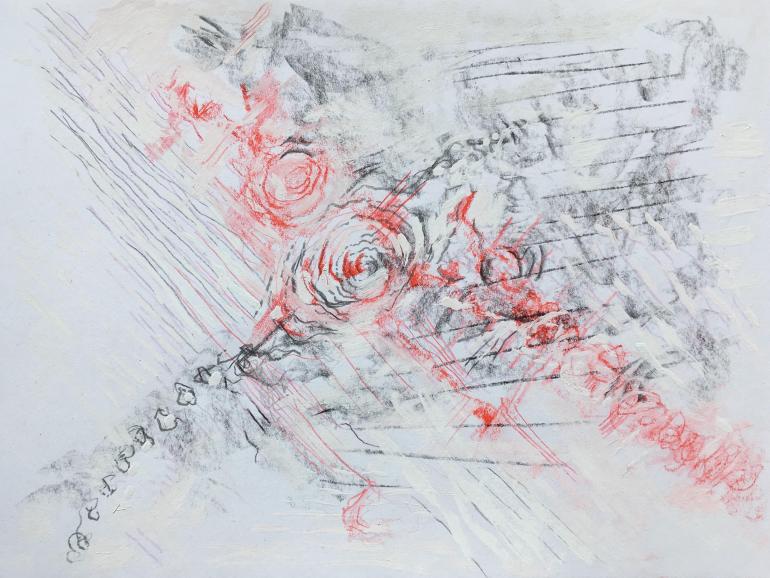
The first part of the DEAD DAY DOG trilogy led to a publication under the same name. The book DEAD DAY DOG is an assemblage of fictionalised documentation material. The main character ‘S’ is a cleaning craft of a performance venue. S falls madly in love and -while encountering remnants of a play- she is confronted with her own traumatic past. Love letters of the cleaning craft are entangled with fragments of the performance. Poetry, drawings and photos reconstruct the play, inviting the reader to navigate through a world of dissociation and avoidance.
*Through the lens of the polyvagal theory** and inspired by Stephen Porges’ idea that we come into the world wired to connect with each other, we question the “knot” of trauma and the different ways in which we, as a society, are entangled within it. Beyond the desire to untie, we work around the aesthetics and the ethics of the knot, weaving different approaches together.
**See Porges, S. The Pocket Guide to the Polyvagal Theory: the Transformative Power of Feeling Safe, 2017.
This project is a collaboration between Mieke Weckesser and Agnes Schneidewind and is supported by Arteventura
 Mieke Maria